
Thought leadership
Over the last eight years we have reviewed and carried out due diligence on over 300 projects, and it is fair to say that only a small percentage of those met investor expectations.
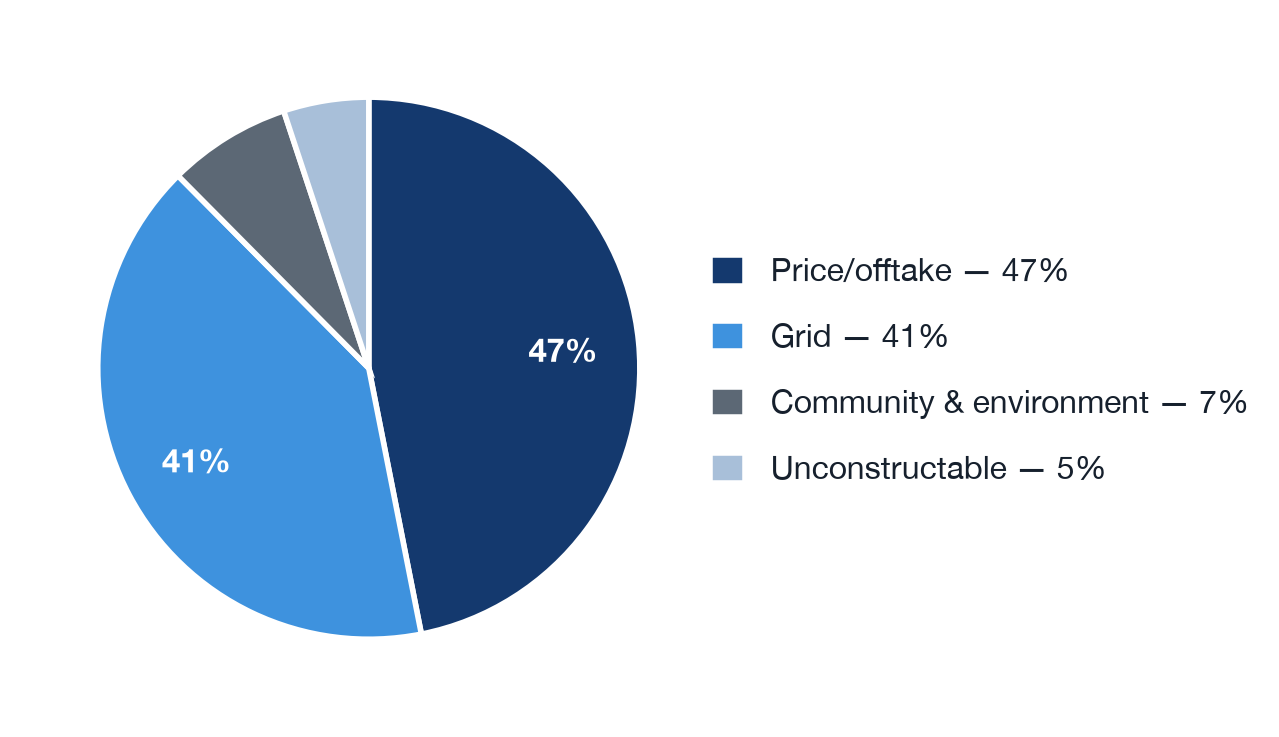
72% negative on grid — curtailment, connection certainty, cost of infrastructure relative to project, capability in grid, and program. There was a trend that most grid connection issues occurred in 132 kV and below, and this could be largely due to the sophistication of players pursuing larger projects.
13% negative on community and environment, due to insufficient engagement and insufficient capturing of those engagements, as well as environmental complexities that introduced unrealisable costs.
9% negative on constructability, with almost all of the projects in this category having never engaged with an EPC or BoP during site selection.
83% negative on pricing, where the assumed revenue taking into account devex and capex costs resulted in equity returns below 10%. In many instances investors are chasing development assets where the returns are at least 12%, due to the higher cost of debt seen in recent years.
Proponents assuming connection capacity that is simply not available. Network constraints, system-strength requirements and potential limitations on import and export materially affected the project's expected operating profile. Importantly, these technical constraints had not been fully reflected in the financial model or development strategy.
Inconsistencies between the project schedule, connection pathway, equipment assumptions and forecast commencement of revenues. In some cases, proponents are suggesting utility-scale projects can be built in 12 months; this has not yet been proved. Left unresolved, these issues had the potential to result in further development expenditure being committed to a project that could not perform in the manner assumed by its investment case.
Recovery projects — once solar, then hydrogen, today a BESS. Stale DAs create problems because they cannot account for new requirements.
We hope you found value in our statistics and favourite faux pas. The outcome demonstrates the value of undertaking due diligence early. Good due diligence does not simply identify what is wrong with a project, it identifies what can be fixed, what value can be protected and whether there is a credible pathway back to investment.
Tell us the asset or the decision and we will tell you what a review would cover.